
20 November 2025
Australian Financial Review – 19/11/2025 – Australia needs 1.9 million extra new homes to bring prices back to levels that would allow a single person on an average salary to buy and comfortably meet loan payments, the country’s largest housing industry body says.
That injection – equal to 16 per cent of the country’s existing housing stock – would lower the national average dwelling price, $773,803, by 40 per cent and keep mortgage payments below 30 per cent of the pretax income of a single buyer making $106,000 a year, according to the Housing Industry Association.
The number is purely theoretical; the HIA’s calculations assume the extra housing is available immediately and do not include the new homes needed to account for the additional demand that would grow over the time it would take to actually build them.
However, the exercise showed the huge shortfall in housing Australia faced even as it struggled to reach 240,00 new housing starts annually to hit the goal of 1.2 million new homes in five years, said HIA chief economist Tim Reardon.
“Getting to 240,000 is just the first step, and from that we need to continue to grow,” he said.
“It’s like [former US president John F. Kennedy] saying we will put a man on the moon by the end of the decade. It is an ambitious goal, and it is right for the federal government to pursue it, to make clear to all tiers of government what the goal is.”
Australia’s surging demand for housing is driven by population growth, immigration and the tendency of the existing population to want more space, as happened during the COVID-19 pandemic, when household sizes fell and people wanted more private areas.
Although shrinking household sizes add to overall demand for housing, that has largely unwound because of affordability.
“You don’t need large changes in household formation to have an impact incrementally, but household formation size has already crept up from the low it reached during the pandemic,” said Oxford Economics Australia senior economist Maree Kilroy.
“Even if we did continue to see a rise in household formation – larger households – we’ll still have an affordability issue.”
The figure of 1.9 million new homes assumes a current mortgage rate of 6.13 per cent for borrowers buying a home at the national average price of $773,803. It currently takes 1.7 average earners – on weekly pretax earnings of $2032 – or $108,000 annually – to keep repayments below the threshold figure of 30 per cent of pretax income.
Based on an estimate by Centre for Independent Studies chief economist and former RBA researcher Peter Tulip that a 1 per cent increase in dwelling stock leads to a 2.5 per cent decline in housing costs, the 40 per cent decline in prices required to bring prices back to an affordable level for a single average earner means 1.9 million new homes.
Apartments picking up
The outlook for apartments is improving. Development is about to pick up after three sluggish years, as buyers have become willing to accept higher prices that make multi-unit projects feasible once again, new HIA figures predicted.
The lobby group predicts housing starts in multi-unit projects, such as apartments, townhouses and semi-detached homes, to jump by a third from 69,265 in the year to June to 91,948 over the next three years.
That is a bigger gain than the 14 per cent increase the HIA predicts in dwelling commencements from 109,836 in the 2025 financial year to 124,664 in 2028, and reflects specific drivers pushing people towards apartments.
By 2030, quarterly commencements of attached homes will approach the level of detached houses, it forecast.
Population growth was fuelling demand, established home prices were rising, and land constraints were pushing buyers towards higher-density living, the HIA Australian Outlook Spring Edition 2025 said. “Multi-unit commencements, which have languished for nearly a decade, are set for a turnaround from 2026.”
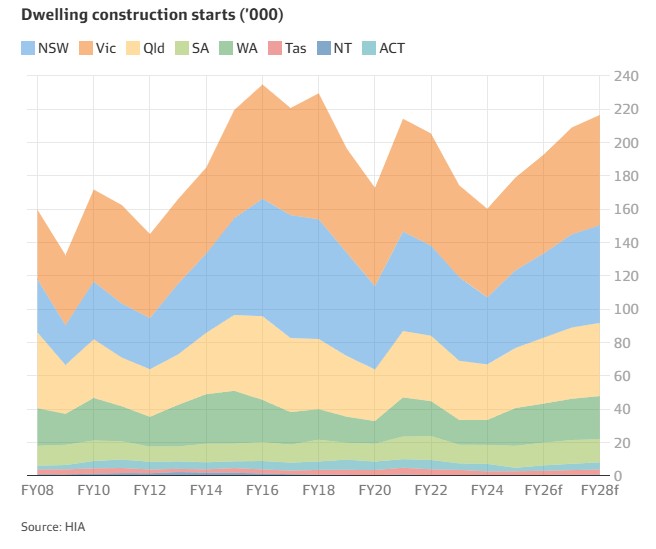
The turnaround in multi-unit developments would be led by Queensland, set to grow the most of the three large states with a near-45 per cent leap, the HIA said. The number of multi-unit starts in Queensland was likely to rise from 12,323 in FY25 to 17,840 by FY28.
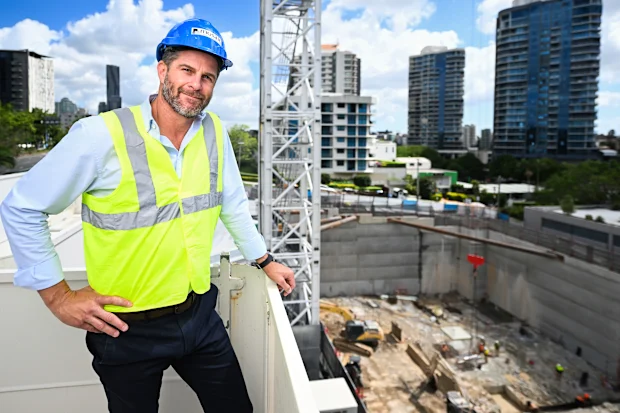
In Brisbane, developer-builder Brook Monahan said selling prices of the luxury apartments he specialises in have risen 35 per cent in the past two years, faster than the 15 per cent gain in construction costs over the same period.
“There is a market that’s now accepted some new high watermarks in terms of where pricing is,” said Monahan, the managing director of Mosaic Property Group. “There are more people conditioned around what a high-quality two- to three-bedroom apartment looks like in the better parts of south-east Queensland.”
His company is six months into construction in Brisbane’s peninsula suburb of Kangaroo Point for a 17-level, 128-apartment building with a big Woolworths store at the bottom. It is 95 per cent sold, at an average rate of $20,000 per square metre.
“The bulk of the project was sold off the plan leading into Christmas last year and early this year,” said Monahan. “Prices would have gone up 10 per cent since then, comfortably.”
However, not all buyers were willing to pay more. For more affordably priced higher-density projects to be viable, prices would need to still rise 8 per cent to 9 per cent annually for the next three years – assuming construction prices rose no more than an annual 6 per cent to 7 per cent over the same period, said Monahan.
And other risks still lurked in the south-east Queensland market, hit by a string of construction-industry insolvencies over the past five years, as a wave of new players sought to tap the demand and higher prices.
“We’ve now got new participants entering the market that don’t necessarily have the experience or track record to be taking on some of the projects that are being mooted for delivery,” said Monahan. “This is very likely to result in risk materialising in years to come.”
More widely, governments – such as in NSW, where the state in June said it would underwrite the sale of up to $50 million worth of apartments in medium-density projects to speed the pace of development – were bringing in changes that would stimulate new development, said HIA economist Reardon.
The extended federal 5 per cent first home buyer guarantee scheme – which removes the need for buyers to take out lender’s mortgage insurance – streamlining planning and boosting land supply were all measures that would accelerate the pace of growth, he said.
“We’re starting to see some of those major levers getting pulled,” said Reardon. “We are starting to see governments very focused and making the big decisions necessary to lower the cost of a completed home.”
The emphasis on speed, through policies such as the NSW low- and mid-rise housing policy, Victoria’s so-called activity centres designated for high-rise development in Melbourne, and revamps of planning laws to reduce the scope for objections would accelerate development faster, he said.
“It is possible that if they continue, we will get to the run rate necessary to build 1.2 million homes by 2030,” said Reardon. “To do that, we’re going to need to see more than a doubling of the volume of apartments commencing construction.”
